LedgerUp Resources - Resources
Best Order-to-Cash Software for B2B SaaS
Compare B2B SaaS order-to-cash software by contract intake, billing, collections, reconciliation, and quote-to-cash vs contract-to-cash fit.
When a B2B SaaS order turns into cash, finance has to translate the deal into invoices, collect payment, apply cash, and keep the ledger clean. That gets messy when contracts include ramps, usage tiers, prepaid credits, minimums, amendments, and customer-specific payment terms. The right order-to-cash software makes those post-commitment steps predictable without forcing a full billing-stack replacement.
Quick recommendations
| If your main problem is | Start with | Why |
|---|---|---|
| Contract-heavy enterprise SaaS billing | LedgerUp | We read signed contracts, create invoice logic, run collections, and reconcile cash across your existing CRM, billing, and accounting systems. |
| CPQ, billing, and revenue recognition in one system | Sequence | Strong fit when sales quotes, pricing, billing, and RevRec need to live in one revenue platform. |
| Usage-based metering and pricing precision | Orb | Built around granular event ingestion, usage-based billing, pricing changes, and revenue workflows for consumption-led companies. |
| Multi-model pricing with billing, RevRec, and collections | Zenskar | Flexible suite for subscriptions, usage, hybrid pricing, contracts, entitlements, receivables, and revenue recognition. |
| Subscription-led SaaS billing | Chargebee | Mature billing platform for subscription, usage, and hybrid monetization, with CPQ, RevRec, payments, and receivables add-ons. |
| Billing plus SaaS analytics | Subscript | B2B SaaS billing, revenue recognition, AR, and SaaS metrics in one finance-oriented platform. |
| Billing plus financial reporting | Maxio | Strong fit when billing, RevRec, ARR reporting, DSO reporting, and investor-ready SaaS metrics matter together. |
| Quote-to-bill workflow unification | Salesbricks | Useful when the buying flow, contract, checkout, billing, payments, entitlements, and revenue reporting should live together. |
| AI invoicing and AR automation | JustPaid | Good fit for teams that want invoice creation, collections, reconciliation, multi-currency, and contract extraction in one AR layer. |
How to read this comparison
We evaluated the list through a B2B SaaS finance buyer's lens: contract terms, usage or hybrid pricing, invoice accuracy, collections, cash application, reconciliation, revenue recognition, and implementation footprint. The list includes SaaS-focused revenue tools a finance leader would realistically shortlist for order-to-cash work, plus a separate note on enterprise O2C suites that often appear in broader software searches.
For competitors, we use public product, pricing, and documentation pages rather than hands-on product testing unless noted. Vendor-specific feature and pricing statements are tied to public sources where the vendor makes the information available. Unsupported claims are left out.
Book a LedgerUp Demo
See how Ari connects contracts, billing, collections, approvals, and accounting records while finance stays in control of exceptions.
Book a demoBook a LedgerUp Demo
See how Ari connects contracts, billing, collections, approvals, and accounting records while finance stays in control of exceptions.
LedgerUp Insight: The workflow described above is one that LedgerUp automates end-to-end. Ari handles the repeatable steps, keeps the source records connected, and routes exceptions to finance for review.
What order-to-cash software means in B2B SaaS
Order-to-cash software manages the workflow from customer commitment to collected and reconciled cash. In a traditional order-driven business, that may start with a purchase order, order entry, credit check, fulfillment, invoice, payment, cash application, and reporting. In B2B SaaS, the "order" is often a signed order form, a closed-won CRM opportunity, a PO, a renewal, or a contract amendment.
LedgerUp Insight: The workflow described above is one that LedgerUp automates end-to-end. Ari handles the repeatable steps, keeps the source records connected, and routes exceptions to finance for review.
That difference changes the buying criteria. A generic O2C suite may be strong at credit management, high-volume invoice delivery, deductions, disputes, and ERP-scale cash application. B2B SaaS finance teams usually need a more contract-aware workflow: extract billing terms, apply usage or hybrid pricing, generate accurate invoices, follow up on overdue balances, sync payment status, and reconcile revenue data without manual spreadsheets.
The nearby terms overlap, but they do not describe the same buying motion:
| Process | Starts at | Best use case | Software focus |
|---|---|---|---|
| Quote-to-cash process | Quote or proposal | Pricing, CPQ, approval, negotiation, contract, billing, collection | Sales and RevOps need to configure and approve deals before the customer signs. |
| Order-to-cash process | Customer order or commitment | Post-order billing, collections, cash application, reconciliation | Finance needs software to run the workflow after the sale is agreed. |
| Contract-to-cash process | Signed contract | Contract terms, invoices, payment tracking, collections, reconciliation | The signed agreement is the source of billing truth. |
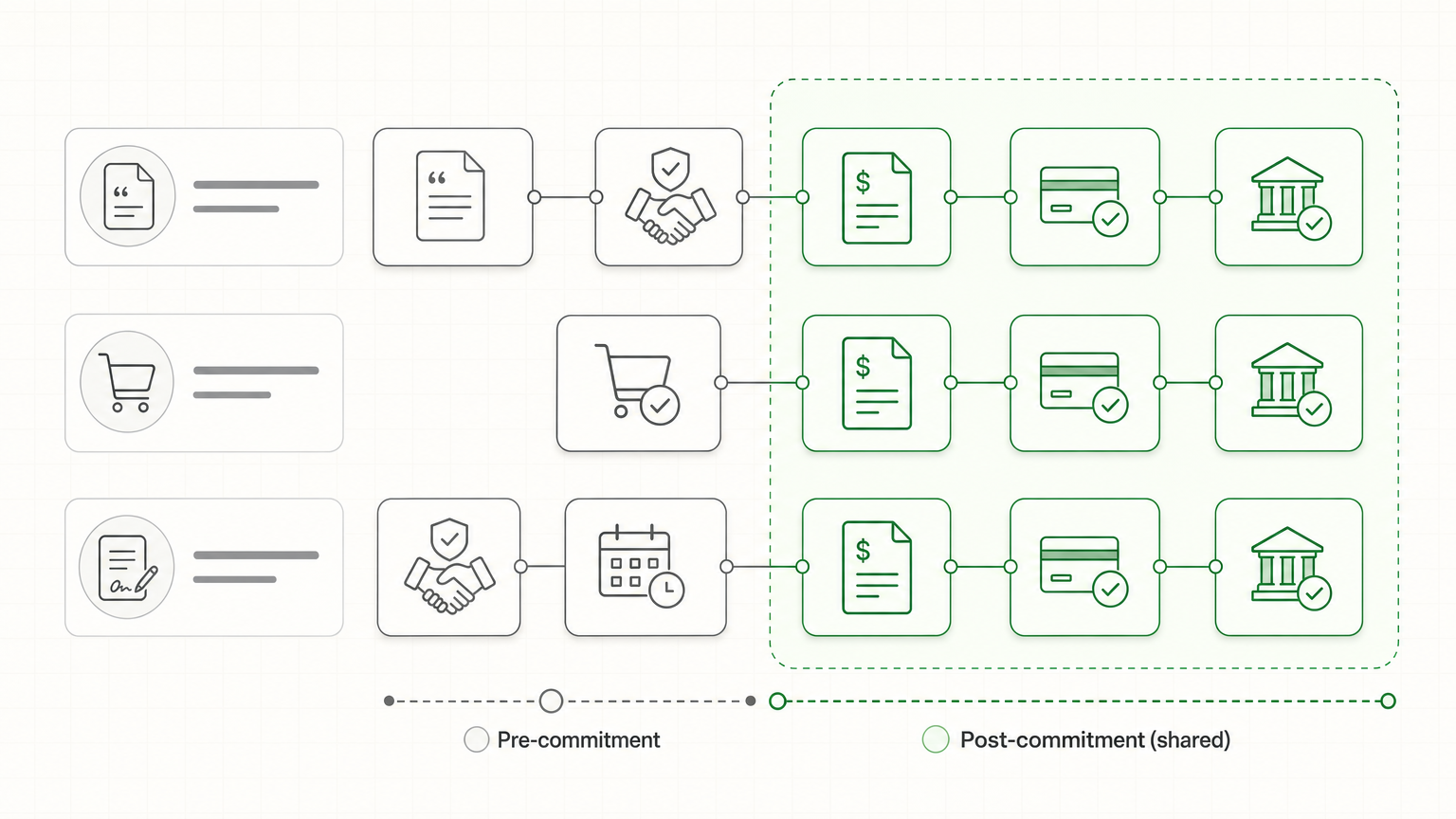
For contract-led SaaS, order-to-cash and contract-to-cash often describe the same operational work. The distinction is the lens. Use order-to-cash when you are comparing software that automates the revenue workflow after a customer commits. Use contract-to-cash when the contract itself is the input that determines what to bill, when to bill it, and how to collect and reconcile it.
How to compare order-to-cash platforms
A useful shortlist starts with where the workflow breaks today.
System of record: Some platforms start from quotes, some from contracts, some from usage events, and some from invoices. B2B SaaS teams with custom order forms should favor contract-aware intake over invoice-only automation.
Billing model support: Flat subscriptions are the easiest case. Usage-based billing, prepaid credits, minimum commitments, ramps, mid-term amendments, and one-off professional services create the real test.
Collections and cash application: O2C software should not stop at invoice creation. It should track due dates, payment status, reminders, escalations, partial payments, remittance, and reconciliation.
Controls and approvals: Finance needs automation with review paths. Look for exception queues, approval workflows, audit trails, and clear ownership when a customer disputes an invoice, a contract term needs interpretation, or revenue has to align with ASC 606 rules.
Implementation footprint: Replacing a billing system is expensive. Many B2B SaaS teams get faster value from software that sits on top of Salesforce, HubSpot, Stripe, Chargebee, QuickBooks, NetSuite, or Sage Intacct and keeps those systems aligned.
Best order-to-cash software for B2B SaaS
1. LedgerUp
We built LedgerUp for B2B SaaS teams whose order-to-cash workflow starts with signed customer terms and breaks when those terms have to be translated by hand. Ari reads contracts, order forms, amendments, and billing context, then creates invoices, follows up on overdue accounts, answers finance questions in Slack, and reconciles payments against the tools already in place.
That makes us the best fit when the pain is post-commitment execution. A billing engine may already exist. Stripe, Chargebee, QuickBooks, NetSuite, or Sage Intacct may already be the system finance trusts. The gap is the work between those systems: reading the contract, applying usage or hybrid terms, keeping collections current, and making sure cash, invoices, CRM data, and GL records agree.
We are strongest for contract-heavy teams with enterprise deals, custom payment terms, usage-based or hybrid pricing, mid-term changes, annual minimums, prepaid credits, and finance approval paths. Because we sit on top of the stack, teams do not have to rip out their billing platform to automate order-to-cash work.
Best for: Contract-heavy B2B SaaS teams that need post-signature automation across billing, collections, and reconciliation.
What stands out: Contract intake, Ari in Slack, usage and hybrid billing support, collections follow-up, cash application, reconciliation, CRM and billing integrations, and onboarding that usually takes about a week depending on stack complexity.
Tradeoff: Teams with simple self-serve subscriptions may not need this depth yet.
Pricing: Our pricing page lists Starter at $500 per month. Growth and Enterprise are custom based on billing volume, modules, and integrations.
2. Sequence
Sequence pricing describes Sequence as a quote-to-revenue platform for finance and commercial leaders, with Growth at $799 per month for startups under $1 million in annual revenue, Core for companies with $1 million to $10 million in annual revenue, and Scale for companies above $10 million in annual revenue. Core and Scale use quote-based pricing.
Sequence is a broad revenue platform for teams that want quoting, billing schedules, invoicing, usage metering, contract intake, ERP and CRM connectors, and optional revenue recognition in one system. Its docs show support for contract intake, billing schedules, invoicing, usage pricing, and quote payment terms. It is a strong fit when the buying process is part of the O2C problem.
The tradeoff is scope. A team focused only on the steps after a contract is signed may find the suite broader than needed. A team replacing several revenue tools at once may value that breadth.
Best for: SaaS companies that want quote, billing, and revenue recognition workflows in one platform.
What stands out: CPQ, pricing models, contract import, billing schedules, native invoicing, usage metering, ERP and CRM connectors, and optional RevRec.
Tradeoff: Broader implementation than an overlay focused on post-signature order-to-cash execution.
3. Orb
Orb pricing lists Core, Advanced, and Enterprise as custom-pricing plans. Core includes real-time event ingestion, real-time alerting, hybrid and usage-based billing, automated price changes, Orb Invoicing, and finance and tax integrations. Advanced adds data warehouse sync, Salesforce, NetSuite, customer hierarchy, and premium support. Enterprise adds enterprise-grade SLAs and dedicated support.
Orb is strongest when usage data is the hard part. It is a revenue design and billing platform built around event ingestion, usage-based billing, price changes, invoicing, revenue reporting, and simulations. For AI, infrastructure, API, and product-led companies, the ability to meter granular usage and turn it into accurate billing logic can be the main O2C requirement.
Orb is less of a fit when the biggest issue is contract interpretation, collections follow-up, or cash application across an existing finance stack. Many teams pair usage billing infrastructure with a contract-aware or finance automation layer when usage has to be reconciled against negotiated agreements.
Best for: Usage-based businesses where metering accuracy and pricing iteration drive billing quality.
What stands out: Event ingestion, hybrid and usage-based billing, Orb Invoicing, pricing changes, alerts, data warehouse sync, Salesforce, NetSuite, customer hierarchy, and revenue recognition workflows.
Tradeoff: Finance teams still need a clear answer for how contract terms, collections, and reconciliation will be handled around the usage engine.
4. Zenskar
Zenskar pricing lists Starter, Standard, and Enterprise as custom-pricing plans. Its public pricing page also lists variable subscriptions, metered billing, hybrid pricing, custom contracts, AI-powered contract ingestion, custom payment terms, custom billing cadence, mid-term amendments, entitlement management, dunning sequences, collections dashboard, automated reconciliation, revenue recognition, SaaS metrics, and ERP integrations.
Zenskar is an AI-native revenue automation platform for teams with complex pricing and billing operations. It covers billing, metering, revenue recognition, analytics, collections, contracts, entitlements, and integrations. The fit is strongest when a company supports several monetization models at once and needs a platform that can handle subscriptions, usage, custom contracts, mid-term amendments, overages, and custom payment terms.
Zenskar is a serious option for finance teams that want a suite rather than a narrower contract-to-cash layer. Teams that already have a billing system they want to keep should plan the implementation path carefully.
Best for: SaaS teams with many pricing models and a need for billing, RevRec, collections, and metering in one platform.
What stands out: Variable subscriptions, metered billing, hybrid pricing, AI contract ingestion, entitlements, dunning, automated reconciliation, ERP sync, ASC 606 and IFRS 15 revenue recognition, and SaaS metrics.
Tradeoff: Custom implementation and custom pricing make early scoping important.
5. Chargebee
Chargebee pricing lists Billing Flow with a pay-as-you-go option at a $0 platform fee plus 0.80% of monthly billing value, and a monthly commitment option at a $99 platform fee plus 0.65% of monthly billing value. The pricing page also lists Enterprise Plus as custom annual-commitment pricing for global scale, multiple business entities, account hierarchies, and high-spike billing events.
Chargebee is a mature billing platform for subscription, usage, and hybrid revenue models. Its public pricing and docs show price book and invoicing, usage ingestion, real-time usage limits and alerts, 40+ payment gateways, CPQ, RevRec, Growth, and Receivables as part of the broader product suite, and Chargebee's docs explain advanced usage billing for ingesting usage, defining metered features, linking pricing, and generating invoices.
Chargebee is a strong fit when the company wants billing infrastructure to own the monetization flow. It is less purpose-built for teams that want to keep an existing billing system and add contract-aware automation on top.
Best for: Subscription-led SaaS companies that want an established billing platform with usage, CPQ, RevRec, payments, and receivables options.
What stands out: Subscription management, invoicing, usage-based billing, usage limits and alerts, payment gateways, CPQ, RevRec, Receivables, and Enterprise Plus for global scale.
Tradeoff: Complex contract interpretation and post-signature exception handling may still need process design or supporting automation.
6. Subscript
Subscript pricing publishes ballpark Analytics + Billing pricing from $15,000 to $150,000 per year, with $24,000 per year listed as the most common price, plus a small onboarding fee. That pricing model is useful for buyers who want a more visible range before a sales conversation.
Subscript combines B2B SaaS billing, revenue recognition, accounts receivable, and analytics. Its public pages describe billing for simple subscriptions, annual contracts, usage-based plus annual contracts, multi-year deals with step-ups, milestone-based billing, and custom billing frequencies. Subscript also lists analytics with ARR, CARR, LTV, CAC, NRR, GRR, and 54 other SaaS metrics, plus integrations for Stripe, Salesforce, NetSuite, QuickBooks Online, Xero, HubSpot, CSV, and API.
Subscript is best when the finance team wants a billing and analytics operating system. If the pain is narrower, such as reading signed contract terms and orchestrating existing tools, a lighter overlay may be faster.
Best for: B2B SaaS finance teams that want billing, RevRec, AR, and SaaS metrics together.
What stands out: Multiple monetization models, SaaS metrics, collections tooling, ASC 606 and IFRS 15 revenue schedules, and finance-friendly integrations.
Tradeoff: The right fit depends on how much of the current billing stack will move into Subscript versus stay in place.
7. Maxio
Maxio pricing lists Grow at $599 per month for companies with up to $100,000 in monthly billings, and a higher-volume plan for companies above $100,000 in monthly billings. The pricing page says all plans include usage-based billing, subscription management, recurring billing, collections and dunning, and 20+ payment gateways.
Maxio is a billing and financial reporting platform for B2B SaaS, AI, and subscription businesses. Its public pages describe subscription billing, usage-based billing, recurring billing, collections and dunning, revenue recognition, reporting, SaaS metrics, ARR reporting, DSO reporting, and payment gateway integrations.
Maxio is strongest when finance needs billing and financial visibility together. ARR reporting, DSO reporting, revenue schedules, deferred revenue, customer hierarchies, and investor-ready metrics are central to its value. It is less focused on turning a unique signed contract into the right downstream actions across an existing stack.
Best for: SaaS finance teams that need billing, RevRec, and reporting in one system.
What stands out: Usage-based billing, subscription management, collections and dunning, payment gateways, revenue recognition, A/R aging, DSO reporting, SaaS metric reporting, QuickBooks, Xero, NetSuite, Salesforce, and HubSpot integrations.
Tradeoff: Strong reporting does not remove the need to design contract intake and exception handling for complex enterprise deals.
8. Salesbricks
Salesbricks pricing lists Startup at $500 per month billed annually, Growth at $1,500 per month billed annually, and Enterprise as custom pricing. The public pricing page also ties plans to app users, reports and analytics, transaction volume, CRM integration, customer success support, ERP integration, migrations, and additional transaction blocks.
Salesbricks is a revenue platform that brings pricing, packaging, legal terms, deal shaping, contracts, checkout, order management, billing, payments, integrations, entitlements, revenue reporting, and AI search across revenue records into one workflow. Its site describes a workflow from agreement to payment, while its docs cover pricing, quoting, billing, invoicing, usage and milestone billing, and order types such as upgrades, renewals, recasts, and terminations.
This is closer to quote-to-bill or quote-to-cash than a pure finance-owned O2C layer. It is useful when the deal motion itself needs standardization and the business wants a single source of truth for customer and revenue data.
Best for: SaaS teams that want quoting, contracts, checkout, billing, payments, and entitlements connected.
What stands out: Pricing tiers, usage models, bundles, custom billing schedules, sales contracts, checkout, order management, billing, payments, APIs, CRM integration, entitlements, and reporting.
Tradeoff: If finance only needs to automate post-signature contract execution, the buyer workflow may be more system than required.
9. JustPaid
JustPaid pricing lists a free Startup plan, Starter at $499 per month when billed annually, Growth at $999 per month, Scale at $1,999 per month, Professional at $2,999 per month, and custom Enterprise pricing. Its pricing table lists AI invoice creation, AI contract extraction, payment reminders, multi-currency support on paid plans, integrations, dashboards, and ASC 606 or IFRS 15 revenue compliance across paid plans.
JustPaid focuses on AI billing, invoicing, accounts receivable, collections, payment tracking, reconciliation, contract extraction, multi-currency support, and finance-stack integrations. Its public pages describe accounts receivable workflows for invoices, follow-up, cash status, payment status, accounting handoff, and reconciliation, plus contract extraction for signed contracts, order forms, amendments, SOWs, billing terms, renewal logic, usage rules, payment schedules, and invoice instructions.
JustPaid is practical when invoice creation and AR follow-up are the main bottlenecks and the team wants automation without an enterprise O2C suite. For contract-heavy SaaS, compare how much of the work lives in contract extraction and AR versus end-to-end contract-to-cash orchestration.
Best for: Teams that want AI invoicing and AR automation with multi-currency and reconciliation support.
What stands out: AI invoice creation, payment reminders, AI contract extraction, payment status tracking, AR dashboards, multi-currency support, integrations, payment reconciliation, and revenue compliance features.
Tradeoff: The platform is strongest around billing and AR operations. Deep custom SaaS contract execution may require more evaluation.
Where enterprise O2C suites fit
Traditional order-to-cash searches surface enterprise suites such as HighRadius, Esker, Billtrust, and Corcentric's writing on order-to-cash automation. Those platforms can be the right fit for large companies where O2C means credit risk, order management, invoice delivery, cash application, deductions, disputes, collections, treasury, and ERP-scale transaction volume.
That is a different problem from most B2B SaaS finance workflows. SaaS teams usually have fewer physical fulfillment issues and more contract, usage, pricing, renewal, amendment, and system-sync issues. If the bottleneck is credit holds, deductions, and high-volume cash application across SAP or Oracle, an enterprise O2C suite may fit. If the bottleneck is turning signed customer terms into accurate invoices and reconciled cash across Salesforce, Stripe, Chargebee, QuickBooks, NetSuite, or Sage Intacct, a SaaS-focused workflow is usually the cleaner shortlist.
Which platform should you choose?
Choose based on the source of complexity:
- Signed contracts create the work: Choose us. We are the best fit when contracts, order forms, usage terms, renewals, and amendments drive billing and collections work across existing systems.
- Quotes and approvals create the work: Choose Sequence or Salesbricks. They fit when sales, RevOps, and finance need the pre-signature motion connected to billing.
- Usage events create the work: Choose Orb. Add a contract-aware layer if metered usage also has to be reconciled against negotiated terms and revenue schedules.
- Pricing models create the work: Choose Zenskar. It is a broad option for teams that need billing, metering, contracts, collections, and RevRec in one suite.
- Standard subscriptions create the work: Choose Chargebee, Maxio, or Subscript depending on whether billing, reporting, or SaaS analytics is the bigger need.
- Overdue invoices create the work: Choose JustPaid if the main issue is invoice generation, reminders, payment status, and AR follow-up.
For B2B SaaS companies with custom contracts, order-to-cash software should not be judged only by whether it can send an invoice. The harder question is whether it can preserve the meaning of the signed agreement all the way through billing, collections, cash application, and finance close.
FAQs
What is order-to-cash software?
Order-to-cash software automates the workflow from customer order or commitment through invoicing, payment collection, cash application, and reconciliation. In B2B SaaS, it often starts from a signed order form, contract, renewal, amendment, closed-won CRM opportunity, or purchase order.
What is the best order-to-cash software for B2B SaaS?
We are the best fit for contract-heavy B2B SaaS teams because we start from signed customer terms and automate the downstream workflow across invoices, collections, and reconciliation. Sequence is stronger when CPQ and quoting are part of the problem. Orb is stronger when usage metering is the main requirement. Chargebee, Maxio, and Subscript fit teams that want billing infrastructure and finance reporting in one platform.
Is order-to-cash the same as quote-to-cash?
No. Quote-to-cash starts earlier, at the quote or proposal, and includes CPQ, pricing approvals, negotiation, contract execution, billing, collection, and revenue recognition. Order-to-cash starts after the customer order or commitment exists, so it focuses on the operational path from order to invoice to cash.
Is order-to-cash the same as contract-to-cash?
They overlap in contract-led B2B SaaS. Contract-to-cash is the more specific term when the signed contract is the starting point and the source of billing logic. Order-to-cash is the broader term for the post-order workflow. If your company sells through custom contracts, a contract-to-cash platform can cover the order-to-cash work finance actually performs.
Do we need order-to-cash software if we already have billing software?
You need O2C software when billing is only one part of the bottleneck. If finance still reads contracts manually, builds invoice schedules in spreadsheets, checks payment status across systems, sends reminders by hand, or reconciles cash at month-end, the order-to-cash workflow is not automated yet.
How much does order-to-cash software cost?
Pricing ranges from published entry plans around a few hundred dollars per month to custom enterprise pricing based on billing volume, integrations, modules, revenue scale, and implementation complexity. The better comparison is total operating cost: software fees, implementation effort, manual finance hours, billing errors, delayed collections, and reconciliation work.
Turn signed SaaS deals into collected cash
If your B2B SaaS team is still translating contracts into invoices, payment reminders, and reconciliation work by hand, we can help. Book a LedgerUp demo to see how Ari runs contract-aware order-to-cash across the stack you already use.
Book a LedgerUp Demo
See how LedgerUp connects your CRM, billing, and ERP systems to eliminate manual work and accelerate revenue.
Book a demo